
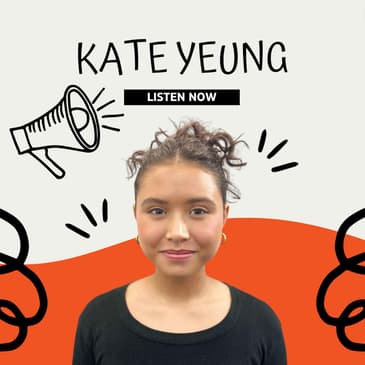
This week’s conversation is with Kate Yeung Ching Yung (she/her) who works as a Project Officer for MYAN, the Multicultural Youth Advocacy Network. MYAN is an Australian non-profit that works in partnership with young people, government, and civil society to promote the rights and interests of young people from refugee and migrant backgrounds and ensure these are recognised in policy and practice.
Originally from Mauritius and now based in Melbourne, Kate first came to Australia in 2019 for university graduating with majors in Drama and International Relations and a minor in Policy and Politics.
My thanks to Nadine Liddy who connected me with Rana Ebrahim, MYAN’s National Manager who introduced me to Kate.
Our conversation covered a variety of topics including Kate’s journey into social advocacy, her move to Australia and examples of MYAN’s advocacy work with young people from refugee and migrant backgrounds. Kate reflected on the importance of young people having a platform, her own sense of power to challenge injustices and her vision for a better world.
Show links:
Multicultural Youth Advocacy Network (MYAN)
Check out the MYAN My Voice Podcast
Model UN (MUN)
Center for Multicultural Youth (CMY)
You can listen to the Citizens Now Podcast on all the usual platforms so please subscribe to get access to episodes as soon as they’re released.
For more information about the show or to share your reflections on what you hear, please check out our website and we're on Instagram. If you'd like to be kept up-to-date on upcoming episodes and seasons please subscribe to the Citizens Now Podcast Substack.
If you’d like to contribute to my tip jar, please check out my Ko-Fi page. I’ve put this podcast together in my spare time and out of my own pocket so any help with meeting operating costs (hosting, website, sound mixing etc) will be greatly appreciated.
Credits:
Created, produced, and hosted by: Debs Erwin
Music: GlowCity
Artwork: Rachel Brady
Sound Editing & Mixing: Stu Reid, Stunt Double Music
TRANSCRIPT
Kate Yeung: “And I think it's also about understanding that young people are, they're just figuring it out. Like I think it just means that they haven't just accepted the way things are like everyone else has”.
INTRO
Welcome to the Citizens Now Podcast! My name is Debs Erwin, and this is a space to hear stories of young people from all over the world who are actively working to bring about positive social change.
This week’s conversation is with Kate Yeung Ching Yung who works as a Project Officer for MYAN, the Multicultural Youth Advocacy Network. MYAN is an Australian non-profit that works in partnership with young people, government, and civil society to promote the rights and interests of young people from refugee and migrant backgrounds.
Originally from Mauritius and now based in Melbourne, Kate first came to Australia in 2019 for university and our conversation started off by exploring Kate’s journey into social advocacy before she tells us more about MYAN’s work with young people from refugee and migrant backgrounds.
INTERVIEW
DE: Kate Yeung Ching Yung, I am absolutely delighted that you are available for the Citizens Now podcast and that you're joining us. I'm really excited about our conversation. Could you tell us a little bit about your journey into social advocacy work?
KY: It's hard to really pinpoint where the journey started because I think recently, we, this made me think of, we had a retreat with a few of our young people the past weekend. And I think the way it starts for a lot of multicultural young people, especially if you are outside of your own community or not surrounded by people necessarily from your own culture is, you don't realize that you’ve become an advocate. You're just kind of existing in this space and it's sort of already intrinsically political. And I think that was really interesting, because a lot of the young people that we have in our network kind of resonated with that and it really made me think as well. I do know that I've always been a pretty strong advocate for myself in all the little ways. Like, I would never let someone say anything that I thought was wrong or was, like, a wrong judgment about me. And I was told that I'm pretty intimidating, and I think it's a label young women usually have when it's not necessarily accurate. It's just, ‘don't insult me’. So, I've always been like this, but I never thought it would bring me into that sort of specific advocacy space for multicultural young people. Since I was very young, I would always have been a feminist, and I would always be like, ‘I can also carry the chairs. Why would you ask not me? I'm probably stronger than these prepubescent, flimsy boys’. I've always had, like, a big mouth in that sense. And I think like social justice sort of came into perspective for me when I started doing MUN and also when I was doing scout work – Girl Guides. So that was more like community, grassroots-based sort of advocacy. But I think when I started seeing further than my community and kind of understanding that we exist with the intersections of so many identities and how that affects us, I think, is when I really started doing the Model United Nations. I've never thought about it that much before, but, yeah, it's definitely what’s kickstarted my passion for social justice and now advocacy. And hopefully that's going to grow over time because I'm just getting started, like I say.
DE: Tell me then about the work that you're doing now with MYAN. You've recently graduated from university, so you've been an international student, you've come a long way, like, in terms of geography. So, what is all of that like?
KY: So I came to Australia and then I went to university here, and that was very challenging because of COVID. So, half of my studies was affected because of COVID. And I had many doubts about if I picked the right thing for me, and if it was, I had a lot of pressure around, ‘well what kind of job are you going to have with a Bachelor of Arts?’ ‘Oh you're studying international relations, so what do you want to become? Like are you just going to be a diplomat?’ Like when I passed, I think the first year at university, I was like, no, this is actually right for me. This is a great combination of topics that I'm studying. I find it interesting, and I'm engaged, and I want to do, and I feel like it's helping me outside of uni, I understand what's going on in the world. Like, when I'm watching the news, it makes sense to me. You know when I see injustice, I feel like it helps me have many lenses to one issue. So now that I'm working at MYAN, it's definitely important to sort of have that level of critical thinking and be able to address problems understanding the root causes and all the factors involved such as, so today, for example, we had a consultation with some settlement services providers and the question was around the experiences of LGBTQIA+ individuals that are seeking asylum in Australia. It's part of a research project that our advocacy and policy lead is doing. So, I think this is the kind of work that really interests me and it's very niche in a, in a way it can be very niche, but then it speaks to a broader perspective as well. And then I feel like it's important to have someone who is looking into these niches because they can't be disregarded. These are still real people's experiences. The whole reason why the research is being conducted is because we've seen the gap in the literature and to be able to influence policy, we need to have data. So, there's going to be like a range of consultations that are happening. So, this is one of the examples of what the type of work I'm doing at MYAN, and I really love it. But also, it's not all just that. Yesterday I was processing invoices so it's a real mix of things which I do like. It just keeps, it's not boring.
DE: Yeah, so can you explain a little bit more about the kind of work that MYAN does? Because it's a national organization in Australia. It's pretty big.
KY: I think, in the broader sense MYAN advocates for young people from a refugee and migrant background. So, we define young people between usually twelve and 24, but a lot of the times under 30 is also used, depending on the context. What we want to focus on is to have a strong network of young people. So, there's the staff of MYAN, which I'm part of, and then we have a couple of young people that fit this criteria, young and multicultural, that are part of our network across Australia. So, in each of our states we have one or two. So, these young people sort of feed into all of the work that we do. And we do our best to make sure that their voice, that they are able to champion their own ideas and that we're not speaking for them. But for example, if we have consultations with different types of stakeholders, we do our best to have these young people with us. So, we bring them to the meetings or the part of the consultations online, or they will be a panellist, or sometimes we allow them to be facilitated so that they can sort of be part of the conversation. So that's what we try to do. And just when I was talking about the retreat last, I think it was two weekends ago, it was just so all our young people from across the state, they all flew into Melbourne and we all met and we had numerous workshops where they looked at their work plan, their goals for the next two years. It's a two-year term for the young people, so they highlight their goals and each of them come with their own lived experience and their own priorities and what they're most passionate about. There will always be those young people who are extremely passionate and keen to work on like gender equality. So, we have all of this information and anytime that we see that there's an opportunity for them to speak out on that or to participate in the forum, we always reach out to them. We just had the federal election in May. So, in the upcoming of the federal election, we presented the young people that were interested from our network the opportunity to speak to the media. So, we had our media consultant be coordinating between media outlets and these young people. So, she would be like, ‘oh, is someone able to write an opinion piece for this specific news outlet?’ And then they would raise their hand and then these young people would just write what they felt and what they thought was important to them, what they expected from this election, their hopes and the standards that they have for the upcoming politicians. So, it's just kind of another example of how we try our best to make sure young people have the platform because they already have a voice, and they already are educated from their lived experience. The only thing that sometimes they don't have is the access because systematically it's been taken away from them just because of their intersecting identities. So, we try to sort of provide them with these opportunities to use this voice they already have because they are motivated, they want to see change, they want to see, and they want to be part of the change. So, we just try to facilitate that basically.
DE: Yeah, that's amazing. It's really encouraging. And I love what you've said about these young people with these specific experiences, already have a voice, but it's really about kind of enabling them to express that, to have that platform. I'm curious what you think, particularly for young migrants, young refugees, young asylum seekers, why is it important that they get to speak to their lived experience?
KY: I will get to that question. I just wanted to highlight something that you said in your question. So, our National Manager, Rana, she had to present at this conference for – like multicultural conference. And I think the reason why I'm saying they already have a voice is because she tried to say in her presentation that they already are empowered. We need to kind of deconstruct that idea that young people don't have sort of their own, agency of their own and opinions of their own, so, we try to springboard on this basis. And to come to your question, there's many answers for this, but I think the one that's very relevant to me right now is that we just had the survey, not the survey, the census. And I think almost half of the population of Australia is, were either born overseas or have parents born overseas. So that means that the sheer amount of people in Australia that are culturally diverse, that have multi-ethnic identities and that have that sort of, I wouldn't say not very unique experience anymore, but it still feels unique because whoever is making all the decisions, whoever's in power, whoever's in high level decision making is not really representing the people that they are working for. Technically they're serving the country. Although I have to say it's looking a lot better now with the new Labour government, which is the most diverse, historically most diverse Australia has ever seen. But I think in fear of becoming complacent, we just have to say it's not enough. I think it's important to stay accountable and make sure that we keep in mind that allowing young people of refugee and migrant background – it's not like some grand gesture of altruism or it's not some - it's not like a little hobby happening. It's just really the people that we need to be represented. Ultimately all the policies that are being made also affect them and yet they're not the ones that are able to make those policies.
DE: You've said so many valuable things and especially that piece about diversity isn't some kind of game. It's not kind of just for the fun of it and it's not performative. It's about real people's lives and them getting to represent what it's like to be them. I'm curious about – actually leading on from that – your sense of your power. You were saying at the start, that you're the kind of person that you didn't want people just to kind of label you in a particular way or say, 'you can't do this'. So, I'm curious about at this point in your life, your sense of your power, how you're stepping into that and what that feels like.
KY: So, I love that you asked this because I think I was a lot more of a confident child than I’m a confident adult. And I think a lot of things happen when you grow up that make you sort of come into a shell. Sometimes you just try to protect your peace and you don't want to sort of create any - actually, this has happened when I came to Australia, I think being in a foreign country, I would still say I'm pretty confident and I still advocate for myself, but I don't think it's with the fierceness I had as an eight-year-old anymore. But I think as a child, you really don't care. You just say what's on your mind. But I don't think that's necessarily a good, a bad thing, sorry. Having sort of taken a step back and now that I can be a bit more mindful of how I approach certain situations and it's also about understanding other people's perspectives, it's really hard to say when the other perspective is you thinking the other person doesn't deserve human rights. But regardless, we try our best. So, I think it's about, like it's hard. I don't know if it's ever going to be like an easy thing to do, to just be an advocate, speak up at any point in time, whatever happens.
DE: So, I'm curious about the kind of world that you want to build, want to create and yeah, sorry, I keep thinking of 'Miss Congeniality' and the desire for world peace. We all want world peace.
KY: World peace!
DE: Yeah, exactly. Like even where you see that, where you are right now in MYAN and the world that you're creating through your work, through your involvements now.
KY: Ideally, I would say a world where we can all have equal access to opportunities and everyone is treated fairly and we follow the rules that we're supposed to follow, but also understand where rules can be harmful to people. But I just feel like I am just one person with one set of opinions and one set of ideals. And even though in my head I'm like, I'm striving towards a world where everyone is happy in the way the world is, it's impossible because everyone will have a different standard of that. But what mine is, I would like to see, like one thing very specific is, I don't know if this is the right term for it, but reparative policies. So, an example is like putting like a gender quota in what the Labour Party did, or I think Harvard had like a 10% people of colour intake every year sort of thing. And I've spoken to people of my generation who disagree, they're like, ‘it's unfair because that's not how it's supposed to be’. And I'm like, ‘well, do you not get that because historically this happened, so now we need to repair it to make this happen and so that eventually things even out?’ Obviously, I'm not a policy expert, but it just makes sense to me. If you take everything into consideration, you can't just say, ‘okay, it's wrong to have 10% people of colour coming into Harvard because that means it'll lower the level of the quality of the student cohort in Harvard’. First of all, that's an assumption that people of colour are less smart than all these other white people. And then second of all, it's, what defines smartness? Like standardized testing is wrong also, it’s such a... I think I would like people to have a bit more nuance in their thinking and have a bit more empathy. I hope that we can all have a bit more of stepping into each other's shoes and try to make policies that are more inclusive of people and allow people to have the choice and allow people to have equal access of opportunity.
DE: What do young people bring to you know generally, what do you think it is that young people can bring to the various challenges that are in this moment? Like, obviously not every young person is the same. So young people are not homogeneous. But do you think that there are certain kind of characteristics that young people, because of their lived experience that they bring to these kinds of social justice issues?
KY: Yes. So, the first thing I'm thinking of is just by virtue of being young, you're a bit, you've had less time around to become a sceptic. Is that the right word? So hopefully is my belief is you're a bit less disillusioned. What I'm trying to say is I think once you've lived in a world and you've accepted a system, even though you believe it's wrong, sometimes you just become complacent, and you're just used to it, and that's just the way things are. But I think just by virtue of being young, you're more likely to feel like ‘I just got here into this world. How is it I've got the rest of my life to live and you're telling me I have to put up with all this?’ So, I think that's how I feel. I feel like maybe that's a shared feeling that young people have and that's why we're so passionate in the sense that there's so much ahead of us that first of all, that lets us know that we have time and space to get the work done, but also it would be for something. So, we would still be here to see the results of it. Although that's not always the case. Some things take generations to change, but I think that's the aim. We want to see change and we want to see, we want to see better outcomes for everyone. And also, the reason why it's important to have the lens of young people as well is they can't vote. Young people can't vote before they're like 18 and sometimes when you turn 18 and you're not registered yet, so you have to wait for the next election. So, you're still part of this society and you still have other things. You still have to pay tax sometimes before you can vote. You still have to do all of these things that require you to be a responsible person and then you still can't make decisions about your democracy. So, I think it's important for us to be loud, especially when it comes to what MYAN does, multicultural young people. So often when you're from refugee background or migrant background, if you're not a citizen in this country yet you can't vote and yet you're still being affected by all of these decisions made on your behalf. Just like me, I can't vote here, but I did let my opinion heard. So, I think young people sort of have, they still have an idealistic view of the world, maybe. And I think it's a good thing to carry with you, even though it can be exhausting, and you get very disappointed a lot of the time. And it's almost sort of embarrassing sometimes when you think, ‘can you believe you think people should have equal rights, live in the real world’! But I think that's, like, the more you get old, the more people sort of like, kind of let go of these ideals and they're just like, ‘oh, well, it is what it is'. Hopefully I don't get old and sad like this.
DE: In terms of youth workers, teachers, anybody who works with young people. What do you think are some of the conversations that you wish that they would have with young people?
KY: Well, we talk a lot about cultural competency and cultural sensitivity at MYAN, and we have our sister organization, CMY who delivers a lot of those trainings and provides all these capacity building services. And I think that's the point where they have to start. There needs to be continuous capacity building in that area, and it has to be done by people who have lived experience and who are always updating their training material and who are doing it. And it has to be done in a meaningful way. So, for example, if we're building aboriginal cultural competency, it has to be done first of all, by aboriginal people. But we also have to acknowledge that even the whole concept of cultural competency training is like this whole westernized framework and that maybe that's not how they want to deliver it. They might want to do storytelling and there has to be more than a tick box approach and there needs to be concessions made for that to happen. And it's only then that I think these professionals will be able to have the right conversations with whether it's young people or people from refugee or migrant background. Because it really affects people's lives, like if someone comes from a persecuted background, comes to Australia, it's not as if they are suddenly safe. They have to be also culturally safe, socially safe. And many times, they're not even physically safe, even though they just came from a country where they are physically persecuted. It's hard for me to really know exactly because I feel like there's so much that we still need to learn. Basically, I think it's about asking young people, multicultural young people, like what they need the space for. Do they want to express their concerns, or do they want to form better connections with their communities, or do they want just a safe space to be away from their communities that can sometimes be too overwhelming. So, I think it has to be coming from them. And I think it's also about understanding that young people are, they're just figuring it out. That doesn't mean they're inexperienced or they're not necessarily naive or... like I think it just means that they haven't just accepted the way things are like everyone else has. So, I think it's fair to understand why young people question everything and why we are able to identify that some things are wrong.
DE: Yeah, so if people want to find out more about MYAN and the work that you're involved in, how would they do that?
KY: So, our website is Myan.org.au, so you can find what we're working on there. So, we have Instagram and Twitter as well, and we have a new-found TikTok account all under MYAN Australia, MYAN - M-Y-A-N. And we have our newsletter that comes every two months. So, if you go on the website, you can subscribe to our newsletter. We also post a lot of opportunities, and if anyone wants to be part of consultations or forums or if we see anything, we usually post them in our newsletter and anyone who's interested and eligible can look into it. Yeah, so that's how.
DE: That's super, yeah, I can definitely vouch for the newsletter. I really enjoy it every time it comes in, it's really informative and it just shows that MYAN always seems to be on the pulse in terms of kind of key issues and always thinking ahead. Kate, this has just been such a pleasure. Thank you so much for making yourself available to us, wish you the absolute best with your work and everything that you're involved in. Thank you so much.
KY: Thank you so much, Debs.
OUTRO
I hope you enjoyed hearing from Kate, I appreciated her thoughtful responses and I felt she was really articulate about how young people already have a voice. I’m also left chewing on what she said about the importance of cultural competency and cultural safety and working hard to enable young people to state their needs. I’d love to know if there is anything that stands out for you from the conversation, so please feel free to share by visiting citizensnowpodcast.org where you will also find a transcript for the episode.
Next week is a special one because we get to follow up on today’s conversation by speaking with Sen Toyotoshi who used to work alongside Kate at MYAN. She has a keen interest in business but is also passionate about social issues especially those related to young people, and we chat about how she brings those things together. Please subscribe so you can get the episode as soon as it’s released.
And if you’re enjoying the podcast, I would be so grateful if you would share it with others and please also give us a rating and review so that more people can find out about it. Thank you.
Finally, if you’d like to contribute to my tip jar, please check out my ko-fi page at ko-fi.com/debserwin, it’s linked in the show notes. Thank you.